Showing posts with label Al Qeada. Show all posts
Showing posts with label Al Qeada. Show all posts
Wednesday, October 21, 2009
Still Reeling from Attacks, Pakistan Mounts Offensive, Shuts Down Schools
Pakistani forces have begun an assault on Taliban and al-Qaeda forces in the remote tribal region of South Waziristan. The assault is a swift response to the suicide attacks that rocked the International Islamic University in Islamabad and which are credit to the terrorist groups. On Wednesday, the government shut down every school across the country in fear of more attacks.

Tuesday, October 20, 2009
4 Dead, 18 Wounded in Attack on Pakistani University
A Pakistani University, frequented by foreign students, was the site for a suicide attack that left 4 people dead. The attack seems to be the retaliation for an army offensive against Taliban and al-Qaida forces. The two who set off the bombs also died.
Monday, October 19, 2009
Flow of Terrorist Recruits Increasing
The New York Times reports that Western counterterrorism officials found that an increasing number of recruits from the West have been attending terrorist training camps in Afghanistan and Pakistan. Al Qaeda officials have made this easier for recruits by developing extensive recruiting networks throughout Europe. Agents also make it easier by providing guidance, money, travel routes and letters of recommendation. Another sign of the internationalization of recruitment networks is the small but growing participation of U.S. residents.
Saturday, October 17, 2009
Tens of thousands of Pakistanis flee Southern Waziristan
Al Jazeera reported today that some 28,000 Pakistani soldiers launched a ground offensive against an estimated 10,000 Taliban, Uzbek and Arab Al-Qaeda militants in the Taliban stronghold of Southern Waziristan. Pakistani troops are advancing in three directions, and tens of thousands of civilians are fleeing in advance of the fighting.
The Pakistani army is advancing from Zhob to the south, Razmak to the north and Jandola from the east, and civilians are fleeing Shakoi and Zangra areas to Northern Waziristan. The UN has been preparing for a mass civilian exodus, and has set up makeshift refugee camps and has stockpiled food and supplies. (For a detailed map of the region, see the U. of Texas map collection.)
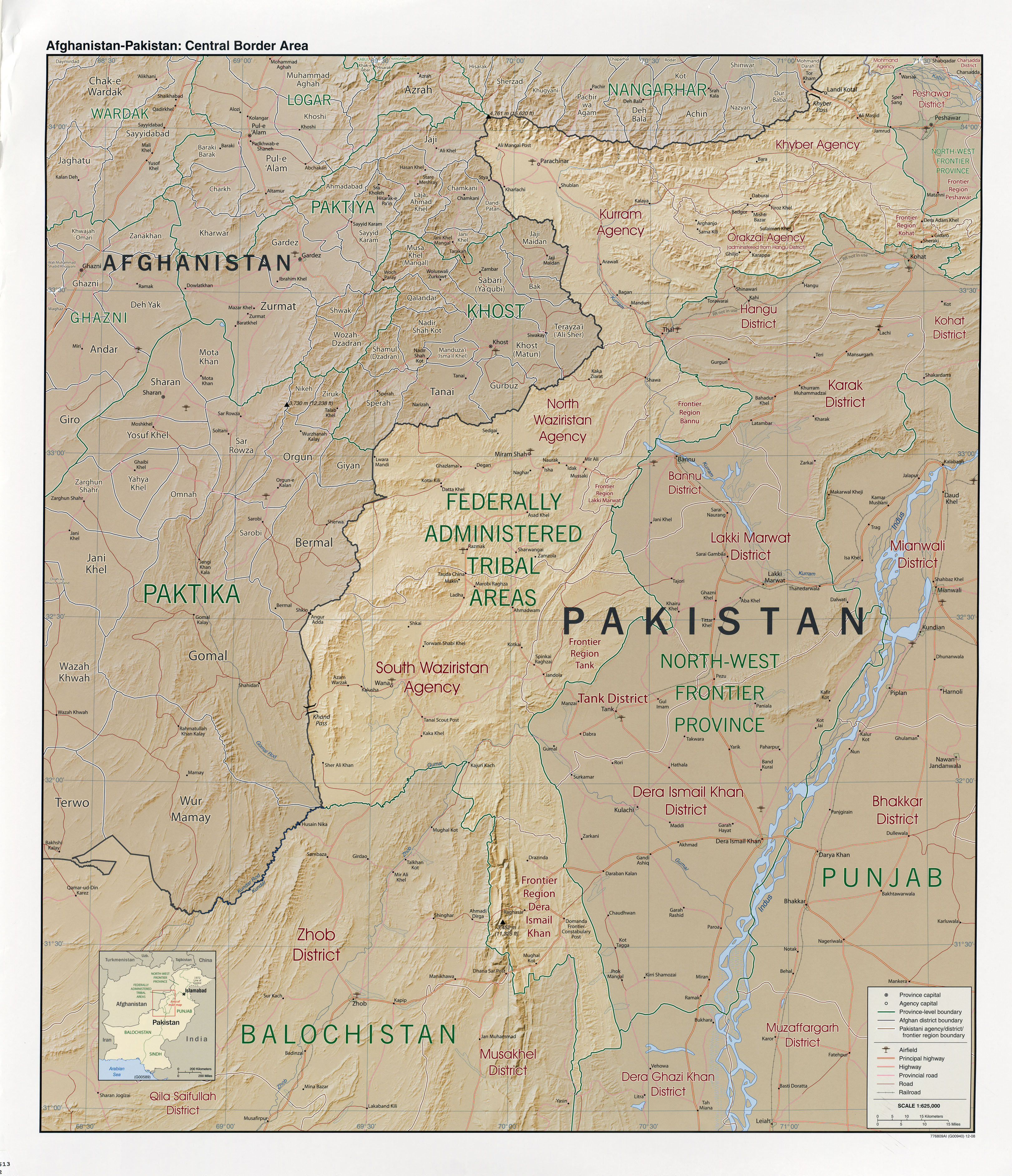
Southern Waziristan was the site of a Pakistani army offensive in 2004, and suffered heavy losses before the government signed a peace pact.
Friday, October 16, 2009
Georgia denies al Qaeda links
Eka Tkeshelashvili, Georgia's Security Council Chief, denied a Russian claim made Thursday that Georgia is conspiring with al Qaeda to send terrorists into Chechnya. Read more at St. Petersburg Times.
Wednesday, October 14, 2009
Change in Priorities, Change in Course?
The New York Times recently reported that President Obama was presented with an alternative strategy for Afghanistan which would require considerably fewer troops than General McChrystal is currently requesting. Rather than treating both as an integrated problem, some senior administration officials are proposing that U.S. troops ease prosecution of Taliban fighters in Afghanistan to focus on Qaeda elements in Pakistan. The premise of this strategy assumes that the Taliban would not provide safe havens to al Qaeda should they return to power in Afghanistan and that a Taliban-controlled Afghanistan would pose no direct threat to the United States. Both Defense Secretary Robert Gates and Secretary of State Hillary Clinton have opposed this line of thinking, warning that any territory controlled by the Taliban will potentially become a staging ground for al Qaeda.
Ironically, Gates and Clinton are revitalizing an argument that Tony Blair made in 2005. Blair cautioned against placing any faith in the discord between terrorist organizations and rogue states because their mutual enmity towards the United States was more powerful. The fact that senior officials are seriously considering this option signifies that the United States has realized it must lower its expectations if it ever expects to see success. If the Taliban truly is an insurgent organization more interested in territorial control than the ideological aims of al Qaeda, what will prevent the Taliban from resorting to Qaeda elements to help them expel American forces? The United States has already seen radical nationalist elements in Iraq fuse with Qaeda insurgents to conduct operations against allied forces despite their conflicting aims.
The probable result of this strategy will be allowing the Taliban to control at least part of the country. In order to prevent cooperation between Qaeda elements and Taliban forces, the United States will be forced to cooperate on some level with the Taliban, therefore legitimizing their regime, even if only in a de facto sense. This would render the invasion of Afghanistan superfluous. If we are now willing to permit the Taliban to rule certain areas of Afghanistan so that we can better prosecute al Qaeda, we could have achieved this with a few missile strikes and strong-arm diplomacy in 2001. We decided then that any enemy that was willing to facilitate a strike against the United States and harbor those responsible needed to be eliminated. To reverse course now would place the entire allied presence in an untenable situation, something that the United States can ill-afford to do.
Ironically, Gates and Clinton are revitalizing an argument that Tony Blair made in 2005. Blair cautioned against placing any faith in the discord between terrorist organizations and rogue states because their mutual enmity towards the United States was more powerful. The fact that senior officials are seriously considering this option signifies that the United States has realized it must lower its expectations if it ever expects to see success. If the Taliban truly is an insurgent organization more interested in territorial control than the ideological aims of al Qaeda, what will prevent the Taliban from resorting to Qaeda elements to help them expel American forces? The United States has already seen radical nationalist elements in Iraq fuse with Qaeda insurgents to conduct operations against allied forces despite their conflicting aims.
The probable result of this strategy will be allowing the Taliban to control at least part of the country. In order to prevent cooperation between Qaeda elements and Taliban forces, the United States will be forced to cooperate on some level with the Taliban, therefore legitimizing their regime, even if only in a de facto sense. This would render the invasion of Afghanistan superfluous. If we are now willing to permit the Taliban to rule certain areas of Afghanistan so that we can better prosecute al Qaeda, we could have achieved this with a few missile strikes and strong-arm diplomacy in 2001. We decided then that any enemy that was willing to facilitate a strike against the United States and harbor those responsible needed to be eliminated. To reverse course now would place the entire allied presence in an untenable situation, something that the United States can ill-afford to do.
Tuesday, October 13, 2009
Military had advance notice of Saturday's attack in Pakistan
Pakistan's police had warned the Pakistani military in July of an attack of the type that was carried out this Saturday on a military command center in Rawalpindi, Punjab province. (Read more at NYTimes.com). Several of the attackers were former military and wore army uniforms, adding fuel to the argument that Pakistan must investigate and root out any links between its ISI and al Qaeda and Pakistan's Taliban. Read more at thewashingtonnote.com or aljazeera.net.
Subscribe to:
Posts (Atom)