Today, the NY Times report that Afghan President Hamid Karzai's brother, Ahmed Wali Karzai, has been receiving payments from the C.I.A. for the past 8 years. Ahmed Karzai is suspected to be a major player in the Afghanistan opium trade, which is the largest opium supplier in the world.
US officials said that Ahmed Karzai helps the C.I.A. operate the Kandahar Strike Force, a paramilitary force that is used in raids against insurgent groups; he is paid for allowing the C.I.A. and American Special Operations to rent a large compound outside of Kandahar; he also helps the C.I.A. communicate and meet with Afghan's loyal to the Taliban.
Showing posts with label Taliban. Show all posts
Showing posts with label Taliban. Show all posts
Wednesday, October 28, 2009

UN Workers Killed in Afghanistan
The UN has suffered the dealiest attack on the organization in 50 years. On Wednesday suicide bombers raided a guesthouse in Kabul that houses UN workers. At least 5 UN workers and 4 Afghans were killed in the attack, with 9 other UN workers being injured. A Taliban spokesman said that this is the first attack in the lead-up to the run-off election. Read more at the BBC.
Car Bomb Explodes in Pakistani Market
A bomb exploded today in a crowded woman's market in Peshawar, Pakistan. Al Jazeera reported today that almost 90 people were killed today, many of whom were women and children, and over 200 were injured. This is one of a series of bombings that have rocket different areas in Pakistan in the two weeks the Pakistani military has been fighting against Tahreek-e-Taliban Pakistan (TTP), the Pakistani Taliban.
There was a bombing Oct. 23 near an air force installation, the assassination of a senior military leader in Islamabad on Oct. 22, two bomber at the International Islamic University in Islamabad on Oct. 20., a bombing at a police station in Peshawar on Oct. 16, a coordinated attack against security facilities in Lahore that killed 28 people on Oct. 15, and a raid on a army headquarters that left 14 dead and ended after a 22 hour standoff on Oct. 10.
Tuesday, October 27, 2009
CFR's Dan Markey and the Prioritization of Pakistan
While numerous pundits debate the pros and cons of escalation in Afghanistan, some political leaders, including Vice President Biden, have emphasized the need for a greater allocation of resources in Pakistan. Some policymakers and scholars have called for this change well before the current debate over Afghanistan troop levels; one of which is Council on Foreign Relations (CFR)'s Senior Fellow for India, Pakistan and South Asia, Daniel Markey.
In April of 2009, Markey published a policy paper advocating greater involvement with Pakistan. As a number of escalation proponents now argue, Markey's paper also calls for a shift from the narrow focus on counterterrorism in Afghanistan. Also, while a lot has transpired between the Spring and Fall of 2009, some of the broader policy goals vis-a-vis Pakistan remain valuable. (See page 13.)
Throughout the week, I'll examine a few of the policy prescriptions in this policy paper, and what they would mean for US security interests in South Asia.
In April of 2009, Markey published a policy paper advocating greater involvement with Pakistan. As a number of escalation proponents now argue, Markey's paper also calls for a shift from the narrow focus on counterterrorism in Afghanistan. Also, while a lot has transpired between the Spring and Fall of 2009, some of the broader policy goals vis-a-vis Pakistan remain valuable. (See page 13.)
Throughout the week, I'll examine a few of the policy prescriptions in this policy paper, and what they would mean for US security interests in South Asia.
10 populous locations in Afghanistan to be Protected by U.S. Troops
Although President Obama has yet to make a formal decision, sources say that more U.S. troops will be sent to Afghanistan. Increased pressure in 10 of the most populous areas and Taliban strongholds are the locations which the U.S. troops will be sent to. To read more, click here NYTimes.
Monday, October 26, 2009
War Gaming Afghanistan
The US Department of Defense modeled the outcomes of the two most likely Afghanistan options available to President Obama this month. The Washington Post reported that these two scenarios were the deployment of 44,000 troops to help the Afghan government gain control of the country, or a more modest 10,000-15,000 troop increase dubbed "counter-terrorism plus."
General Stanley McChrystal drew criticism from members of the administration for publicly espousing favor for a large deployment earlier this month. McChrystal said that he would need at least 44,000 troops to force the Taliban out of populated areas and secure those areas until Afghan forces could take over. Both of the possible troop levels in the war game exercise were based on plans recommended by Gen. McChrystal. The 10,000-15,000 troop increase option would not include plans to force out Taliban shadow governments operating in Southern and Western Afghanistan. McChrystal also included an option that called for 80,000 troops, but this is not getting serious consideration.
Saturday, October 24, 2009
Pakastani Army Captures Taliban Stronghold
The Pakistani army announced today that it has recaptured Kotkai, a city in southern Waziristan (read more at NYTimes.com). The capture of Kotkai is a very important strategic and symbolic victory for the Pakastani offensive against the Taliban in Waziristan. It is the hometown of Pakastani Taliban leader Hakimullah Mehsud and the organizer of the Taliban's suicide bombing squads, Qari Hussain. Mehsud took over leadership of the Pakistani Taliban, or Tehrik-e-Taliban, after Baitullah Mehsud was killed in a CIA drone attack in August.

The Pakistan military had captured Kotkai earlier this week, but the Taliban retook the town early Tuesday morning, killing seven Pakistani soldiers and destroying a checkpoint outside of the city. Fighting is now expected to move into more rugged and mountainous terrain as the Pakistani military rushes to complete its objectives before the coming winter. (Read more at BBC).

Map from bbc.co.uk. Click to enlarge.
Thursday, October 22, 2009
UN Report Concludes that Worldwide Anti-Narcotics Efforts are Flawed
A report released by the United Nations' Office on Drugs and Crime (UNODC) reports that about 900 tons of opium and 375 tons flow out of Afghanistan through Central Asia to the rest of the world. UNODC estimated that when the Taliban was in power in the 1990's, they were earning between $75-100 million a year, but in 2005 they earned about $90-160 million.
The report also spoke of how little of the opium is seized: between 4-5% in Central Asian and Russia and less than 2% in south-eastern Europe, both regions where most of opium leaves Afghanistan. Inside of Afghanistan, where interdiction would be most effective, less than 2% of the opium and heroin is seized, as compared 36% of cocaine in Colombia.
Read more at RFE/RL.
Tighter Links Between Pakistani Militant Groups
Punjabi militant groups, including Laskar-e-Jhangvi and Jaish-e-Muhammad, once thought by many Pakistanis as allies against India, the United States, and Shiite Muslims, may have strengthened ties with Al Qaeda and the Taliban.
Tehrik-e-Taliban, the main Taliban militant umbrella group in Pakistan, with aims to overthrow the Pakistani government, showed in recent coordinated attacks in Lahore and Rawalpindi that it is starting to coordinate closely with Al Qaeda and the Punjabi militant groups, in an effort to overthrow the Pakistani government. Such a combination poses grave danger to stability in the country.
Senior Military Leader Assassinated in Islamabad
Pakistani army brigadier Moinudin Ahmed, who helped plan military operations in Swat and Bajaur, was assassinated in Islamabad today. At about 0930 this morning, two young men on motorcycles fired into the brigadier's jeep, killing the officer and his driver, and then sped away into traffic.
This was most certainly a reprisal for the current military operation in southern Waziristan. Also, the brigadier helped plan the 2007 Operation Silence against the Red Mosque in Islamabad, which might have made him a particular target of opportunity for Islamist militants.
Wednesday, October 21, 2009
Pakistani soldiers emersed in fight against Taliban and Al Qaeda
The Mehsud tribal territory of Pakistan is known as one of the regions most difficult to deal with. Pakistani soldiers have been immersed in a fight with the Taliban and Al Qaeda in the region and have lost several troops recently. But, there is hope as Pakistan has garnered deals with new allies. To read more, click here NYTimes.
Still Reeling from Attacks, Pakistan Mounts Offensive, Shuts Down Schools
Pakistani forces have begun an assault on Taliban and al-Qaeda forces in the remote tribal region of South Waziristan. The assault is a swift response to the suicide attacks that rocked the International Islamic University in Islamabad and which are credit to the terrorist groups. On Wednesday, the government shut down every school across the country in fear of more attacks.
Tuesday, October 20, 2009
4 Dead, 18 Wounded in Attack on Pakistani University
A Pakistani University, frequented by foreign students, was the site for a suicide attack that left 4 people dead. The attack seems to be the retaliation for an army offensive against Taliban and al-Qaida forces. The two who set off the bombs also died.
Sunday, October 18, 2009
Pakistani offensive enters its second day.
Hamid Nawaz, a former Pakistani general, said that he believes the operation could be completed before the December snowfall, Al Jazeera reported Sunday. Five soldiers and sixty militants were killed in the first day of the offensive, which began yesterday, in South Waziristan.
Intelligence officials said Pakistani troops are advancing mainly from the north, with flanks on the south and east, pushing against the mountainous Afghan border to the west. The army reports it has captured the towns of Tank, Jandola and at Spinkai Raghzai as Taliban fighters fled Saturday, and fighting is still taking place outside of Spinkai Raghzai as well as Kalkala and Sharwangai. (See a detailed map at the U. of Texas library) The Pakistan army is hoping to surround and capture Tehreek-e-Taliban (TTP) strongholds in the operation, including Makin, Ladha, Kanigurram and Kotkia, the hometown of Pakistani Taliban chief Hakimullah Mehsud.
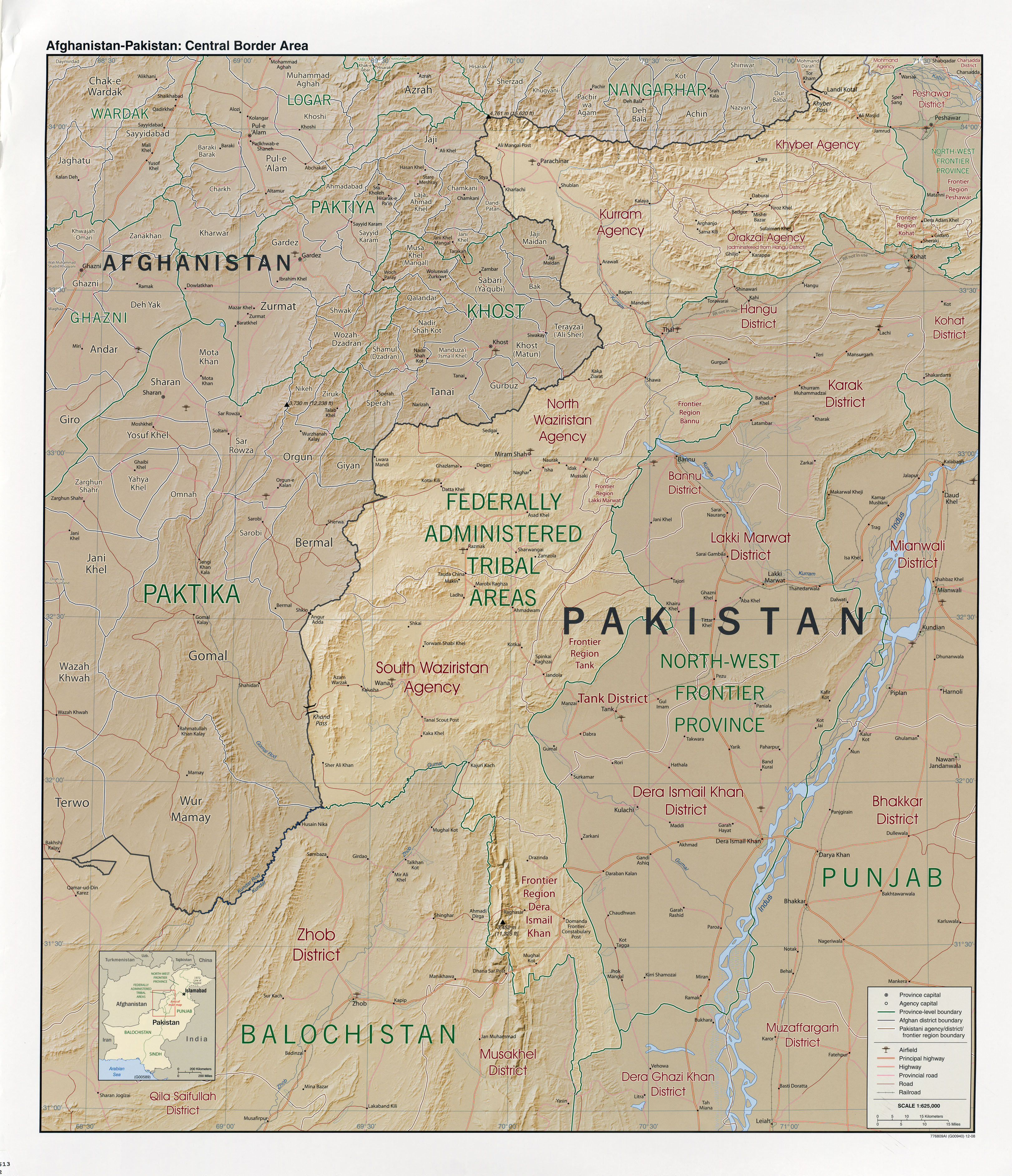
As many as 150,000 civilians have fled the area in the months leading up to the offensive, but an estimated 350,000 still remain. The UNHCR reported Friday, before the new offensive started, that getting care to the refugees is complicated by the security situation in Pakistan, as well as the estimated 2 million people who fled Swat, Buner, Shangla and Dir earlier this year.
Saturday, October 17, 2009
Tens of thousands of Pakistanis flee Southern Waziristan
Al Jazeera reported today that some 28,000 Pakistani soldiers launched a ground offensive against an estimated 10,000 Taliban, Uzbek and Arab Al-Qaeda militants in the Taliban stronghold of Southern Waziristan. Pakistani troops are advancing in three directions, and tens of thousands of civilians are fleeing in advance of the fighting.
The Pakistani army is advancing from Zhob to the south, Razmak to the north and Jandola from the east, and civilians are fleeing Shakoi and Zangra areas to Northern Waziristan. The UN has been preparing for a mass civilian exodus, and has set up makeshift refugee camps and has stockpiled food and supplies. (For a detailed map of the region, see the U. of Texas map collection.)
Southern Waziristan was the site of a Pakistani army offensive in 2004, and suffered heavy losses before the government signed a peace pact.
Pakistan Launches Taliban Assault
BBC News reports that Pakistan has launched an offensive against Taliban militants in the South Waziristan area that could last for up to two months according the to army's top spokesman.
Thursday, October 15, 2009
Italy accused of bribing Taliban for safety in Afghanistan
The Times of London accused Italy of issuing secret payments to Taliban fighters in the Sarobi region of Afghanistan. The Times claims that when the French took over in Sarobi, they weren't informed that the relative peace in the area was kept through payments. Read more at TimesOnline.uk.
Wednesday, October 14, 2009
Change in Priorities, Change in Course?
The New York Times recently reported that President Obama was presented with an alternative strategy for Afghanistan which would require considerably fewer troops than General McChrystal is currently requesting. Rather than treating both as an integrated problem, some senior administration officials are proposing that U.S. troops ease prosecution of Taliban fighters in Afghanistan to focus on Qaeda elements in Pakistan. The premise of this strategy assumes that the Taliban would not provide safe havens to al Qaeda should they return to power in Afghanistan and that a Taliban-controlled Afghanistan would pose no direct threat to the United States. Both Defense Secretary Robert Gates and Secretary of State Hillary Clinton have opposed this line of thinking, warning that any territory controlled by the Taliban will potentially become a staging ground for al Qaeda.
Ironically, Gates and Clinton are revitalizing an argument that Tony Blair made in 2005. Blair cautioned against placing any faith in the discord between terrorist organizations and rogue states because their mutual enmity towards the United States was more powerful. The fact that senior officials are seriously considering this option signifies that the United States has realized it must lower its expectations if it ever expects to see success. If the Taliban truly is an insurgent organization more interested in territorial control than the ideological aims of al Qaeda, what will prevent the Taliban from resorting to Qaeda elements to help them expel American forces? The United States has already seen radical nationalist elements in Iraq fuse with Qaeda insurgents to conduct operations against allied forces despite their conflicting aims.
The probable result of this strategy will be allowing the Taliban to control at least part of the country. In order to prevent cooperation between Qaeda elements and Taliban forces, the United States will be forced to cooperate on some level with the Taliban, therefore legitimizing their regime, even if only in a de facto sense. This would render the invasion of Afghanistan superfluous. If we are now willing to permit the Taliban to rule certain areas of Afghanistan so that we can better prosecute al Qaeda, we could have achieved this with a few missile strikes and strong-arm diplomacy in 2001. We decided then that any enemy that was willing to facilitate a strike against the United States and harbor those responsible needed to be eliminated. To reverse course now would place the entire allied presence in an untenable situation, something that the United States can ill-afford to do.
Ironically, Gates and Clinton are revitalizing an argument that Tony Blair made in 2005. Blair cautioned against placing any faith in the discord between terrorist organizations and rogue states because their mutual enmity towards the United States was more powerful. The fact that senior officials are seriously considering this option signifies that the United States has realized it must lower its expectations if it ever expects to see success. If the Taliban truly is an insurgent organization more interested in territorial control than the ideological aims of al Qaeda, what will prevent the Taliban from resorting to Qaeda elements to help them expel American forces? The United States has already seen radical nationalist elements in Iraq fuse with Qaeda insurgents to conduct operations against allied forces despite their conflicting aims.
The probable result of this strategy will be allowing the Taliban to control at least part of the country. In order to prevent cooperation between Qaeda elements and Taliban forces, the United States will be forced to cooperate on some level with the Taliban, therefore legitimizing their regime, even if only in a de facto sense. This would render the invasion of Afghanistan superfluous. If we are now willing to permit the Taliban to rule certain areas of Afghanistan so that we can better prosecute al Qaeda, we could have achieved this with a few missile strikes and strong-arm diplomacy in 2001. We decided then that any enemy that was willing to facilitate a strike against the United States and harbor those responsible needed to be eliminated. To reverse course now would place the entire allied presence in an untenable situation, something that the United States can ill-afford to do.
Tuesday, October 13, 2009
Military had advance notice of Saturday's attack in Pakistan
Pakistan's police had warned the Pakistani military in July of an attack of the type that was carried out this Saturday on a military command center in Rawalpindi, Punjab province. (Read more at NYTimes.com). Several of the attackers were former military and wore army uniforms, adding fuel to the argument that Pakistan must investigate and root out any links between its ISI and al Qaeda and Pakistan's Taliban. Read more at thewashingtonnote.com or aljazeera.net.
Subscribe to:
Posts (Atom)