Showing posts with label Pakistan. Show all posts
Showing posts with label Pakistan. Show all posts
Friday, October 30, 2009
Pakistan criticized for al Qaeda efforts
U.S. Secretary of State Hillary Clinton issued a sharp rebuke of Pakistan's efforts against al Qaeda. Speaking to a group a Pakistani journalist while on a fence-mending tour of the country, Clinton said she found it "hard to believe that nobody in your government knows where they are and couldn't get them if they really wanted to." Though the main purpose of her visit was to improve strained relations, Clinton also criticized Pakistan's military establishment and tax practices. Mrs. Clinton's tour of Pakistan comes at a time of heavy criticism of U.S. drone strikes in the western region of Pakistan which some believe violate Pakistan's sovereignty. Read more at the Los Angeles Times.

Thursday, October 29, 2009
US Drone Killings Criticized by UN Special Rapporteur
On Tuesday, Philip Alston, a UN Special Rapporteur, voiced concerns about the international legal basis for unmanned drone killings on the Afghan border.
AU Law's own Professor Kenneth Anderson has provided prior scholarship on international law related to targeted killings. Recently, he's also blogged on this particular story at OpinioJuris.org. In these last two documents, Professor Anderson argues that the drone program is perfectly legal, as the United States is legitimately acting in its own self-defense.
Should the Obama Administration, as Anderson suggests, assert such legal bases more clearly? This is a compelling argument, especially if the program is, on the merits, the best method for narrowly targeting terrorists and avoiding innocents.
AU Law's own Professor Kenneth Anderson has provided prior scholarship on international law related to targeted killings. Recently, he's also blogged on this particular story at OpinioJuris.org. In these last two documents, Professor Anderson argues that the drone program is perfectly legal, as the United States is legitimately acting in its own self-defense.
Should the Obama Administration, as Anderson suggests, assert such legal bases more clearly? This is a compelling argument, especially if the program is, on the merits, the best method for narrowly targeting terrorists and avoiding innocents.
Wednesday, October 28, 2009
Global Rise in IEDs
Although we hear a lot about IEDs in Iraq, Afghanistan and Pakistan, global use of improvised explosive devises (IEDs) is on the rise. According to a study published in the New York Times, the number of IEDs exploded or discovered worldwide rose from 3,267 in 2006 to 4,027 in 2007 to 4,273 in 2008.
Although the number of devices exploded or discovered has decreased dramatically in Iraq, they are on the rise in Afghanistan, Pakistan, Sri Lanka, Thailand, Colombia, Somalia, the Philippines, and parts of North Africa. Lt. Gen. Thomas Metz, who is in charge of a Pentagon program to counter IEDs, said that the devices are becoming a favorite tool amongst terrorist and insurgent groups, and is a trend that is likely to continue for decades to come. There is even information that North Korea is training its soldiers in the use of such devices.
Car Bomb Explodes in Pakistani Market
A bomb exploded today in a crowded woman's market in Peshawar, Pakistan. Al Jazeera reported today that almost 90 people were killed today, many of whom were women and children, and over 200 were injured. This is one of a series of bombings that have rocket different areas in Pakistan in the two weeks the Pakistani military has been fighting against Tahreek-e-Taliban Pakistan (TTP), the Pakistani Taliban.
There was a bombing Oct. 23 near an air force installation, the assassination of a senior military leader in Islamabad on Oct. 22, two bomber at the International Islamic University in Islamabad on Oct. 20., a bombing at a police station in Peshawar on Oct. 16, a coordinated attack against security facilities in Lahore that killed 28 people on Oct. 15, and a raid on a army headquarters that left 14 dead and ended after a 22 hour standoff on Oct. 10.
Tuesday, October 27, 2009
CFR's Dan Markey and the Prioritization of Pakistan
While numerous pundits debate the pros and cons of escalation in Afghanistan, some political leaders, including Vice President Biden, have emphasized the need for a greater allocation of resources in Pakistan. Some policymakers and scholars have called for this change well before the current debate over Afghanistan troop levels; one of which is Council on Foreign Relations (CFR)'s Senior Fellow for India, Pakistan and South Asia, Daniel Markey.
In April of 2009, Markey published a policy paper advocating greater involvement with Pakistan. As a number of escalation proponents now argue, Markey's paper also calls for a shift from the narrow focus on counterterrorism in Afghanistan. Also, while a lot has transpired between the Spring and Fall of 2009, some of the broader policy goals vis-a-vis Pakistan remain valuable. (See page 13.)
Throughout the week, I'll examine a few of the policy prescriptions in this policy paper, and what they would mean for US security interests in South Asia.
In April of 2009, Markey published a policy paper advocating greater involvement with Pakistan. As a number of escalation proponents now argue, Markey's paper also calls for a shift from the narrow focus on counterterrorism in Afghanistan. Also, while a lot has transpired between the Spring and Fall of 2009, some of the broader policy goals vis-a-vis Pakistan remain valuable. (See page 13.)
Throughout the week, I'll examine a few of the policy prescriptions in this policy paper, and what they would mean for US security interests in South Asia.
Monday, October 26, 2009
Revolutionary Guard Arrested in Pakistan
Eleven members of Iran's elite Revolutionary Guard and two vehicles were detained in Pakistan by police near the Iran-Pakistan border today. BBC reports that the Guard members were found eight days after a bombing in Iran near the border killed 42 people, including six Revolutionary Guard commanders. Iran claimed that a Jundallah, a Sunni militant group based in Balochistan, Pakistan, had committed the bombing, and had called on Pakistan to investigate.
Saturday, October 24, 2009
Pakastani Army Captures Taliban Stronghold
The Pakistani army announced today that it has recaptured Kotkai, a city in southern Waziristan (read more at NYTimes.com). The capture of Kotkai is a very important strategic and symbolic victory for the Pakastani offensive against the Taliban in Waziristan. It is the hometown of Pakastani Taliban leader Hakimullah Mehsud and the organizer of the Taliban's suicide bombing squads, Qari Hussain. Mehsud took over leadership of the Pakistani Taliban, or Tehrik-e-Taliban, after Baitullah Mehsud was killed in a CIA drone attack in August.

The Pakistan military had captured Kotkai earlier this week, but the Taliban retook the town early Tuesday morning, killing seven Pakistani soldiers and destroying a checkpoint outside of the city. Fighting is now expected to move into more rugged and mountainous terrain as the Pakistani military rushes to complete its objectives before the coming winter. (Read more at BBC).

Map from bbc.co.uk. Click to enlarge.
Thursday, October 22, 2009
Tighter Links Between Pakistani Militant Groups
Punjabi militant groups, including Laskar-e-Jhangvi and Jaish-e-Muhammad, once thought by many Pakistanis as allies against India, the United States, and Shiite Muslims, may have strengthened ties with Al Qaeda and the Taliban.
Tehrik-e-Taliban, the main Taliban militant umbrella group in Pakistan, with aims to overthrow the Pakistani government, showed in recent coordinated attacks in Lahore and Rawalpindi that it is starting to coordinate closely with Al Qaeda and the Punjabi militant groups, in an effort to overthrow the Pakistani government. Such a combination poses grave danger to stability in the country.
Senior Military Leader Assassinated in Islamabad
Pakistani army brigadier Moinudin Ahmed, who helped plan military operations in Swat and Bajaur, was assassinated in Islamabad today. At about 0930 this morning, two young men on motorcycles fired into the brigadier's jeep, killing the officer and his driver, and then sped away into traffic.
This was most certainly a reprisal for the current military operation in southern Waziristan. Also, the brigadier helped plan the 2007 Operation Silence against the Red Mosque in Islamabad, which might have made him a particular target of opportunity for Islamist militants.
Wednesday, October 21, 2009
Pakistani soldiers emersed in fight against Taliban and Al Qaeda
The Mehsud tribal territory of Pakistan is known as one of the regions most difficult to deal with. Pakistani soldiers have been immersed in a fight with the Taliban and Al Qaeda in the region and have lost several troops recently. But, there is hope as Pakistan has garnered deals with new allies. To read more, click here NYTimes.
Still Reeling from Attacks, Pakistan Mounts Offensive, Shuts Down Schools
Pakistani forces have begun an assault on Taliban and al-Qaeda forces in the remote tribal region of South Waziristan. The assault is a swift response to the suicide attacks that rocked the International Islamic University in Islamabad and which are credit to the terrorist groups. On Wednesday, the government shut down every school across the country in fear of more attacks.
Tuesday, October 20, 2009
4 Dead, 18 Wounded in Attack on Pakistani University
A Pakistani University, frequented by foreign students, was the site for a suicide attack that left 4 people dead. The attack seems to be the retaliation for an army offensive against Taliban and al-Qaida forces. The two who set off the bombs also died.
Monday, October 19, 2009
Flow of Terrorist Recruits Increasing
The New York Times reports that Western counterterrorism officials found that an increasing number of recruits from the West have been attending terrorist training camps in Afghanistan and Pakistan. Al Qaeda officials have made this easier for recruits by developing extensive recruiting networks throughout Europe. Agents also make it easier by providing guidance, money, travel routes and letters of recommendation. Another sign of the internationalization of recruitment networks is the small but growing participation of U.S. residents.
Iran rocked by attacks
As talks about Iran's nuclear program are set to resume, suicide attacks have rocked the southeast region of Iran, which borders Pakistan. The attack killed 5 commanders of Iran's Islamic Revolutionary Guards and left dozens dead and wounded. The attacks seem to suggest an escalation between Iran's ruling leadership and the Baluchi ethnic minority. Additionally, Iran has accused the United States, Britain, and Pakistan of supporting the Baluchi.
Sunday, October 18, 2009
Pakistani offensive enters its second day.
Hamid Nawaz, a former Pakistani general, said that he believes the operation could be completed before the December snowfall, Al Jazeera reported Sunday. Five soldiers and sixty militants were killed in the first day of the offensive, which began yesterday, in South Waziristan.
Intelligence officials said Pakistani troops are advancing mainly from the north, with flanks on the south and east, pushing against the mountainous Afghan border to the west. The army reports it has captured the towns of Tank, Jandola and at Spinkai Raghzai as Taliban fighters fled Saturday, and fighting is still taking place outside of Spinkai Raghzai as well as Kalkala and Sharwangai. (See a detailed map at the U. of Texas library) The Pakistan army is hoping to surround and capture Tehreek-e-Taliban (TTP) strongholds in the operation, including Makin, Ladha, Kanigurram and Kotkia, the hometown of Pakistani Taliban chief Hakimullah Mehsud.
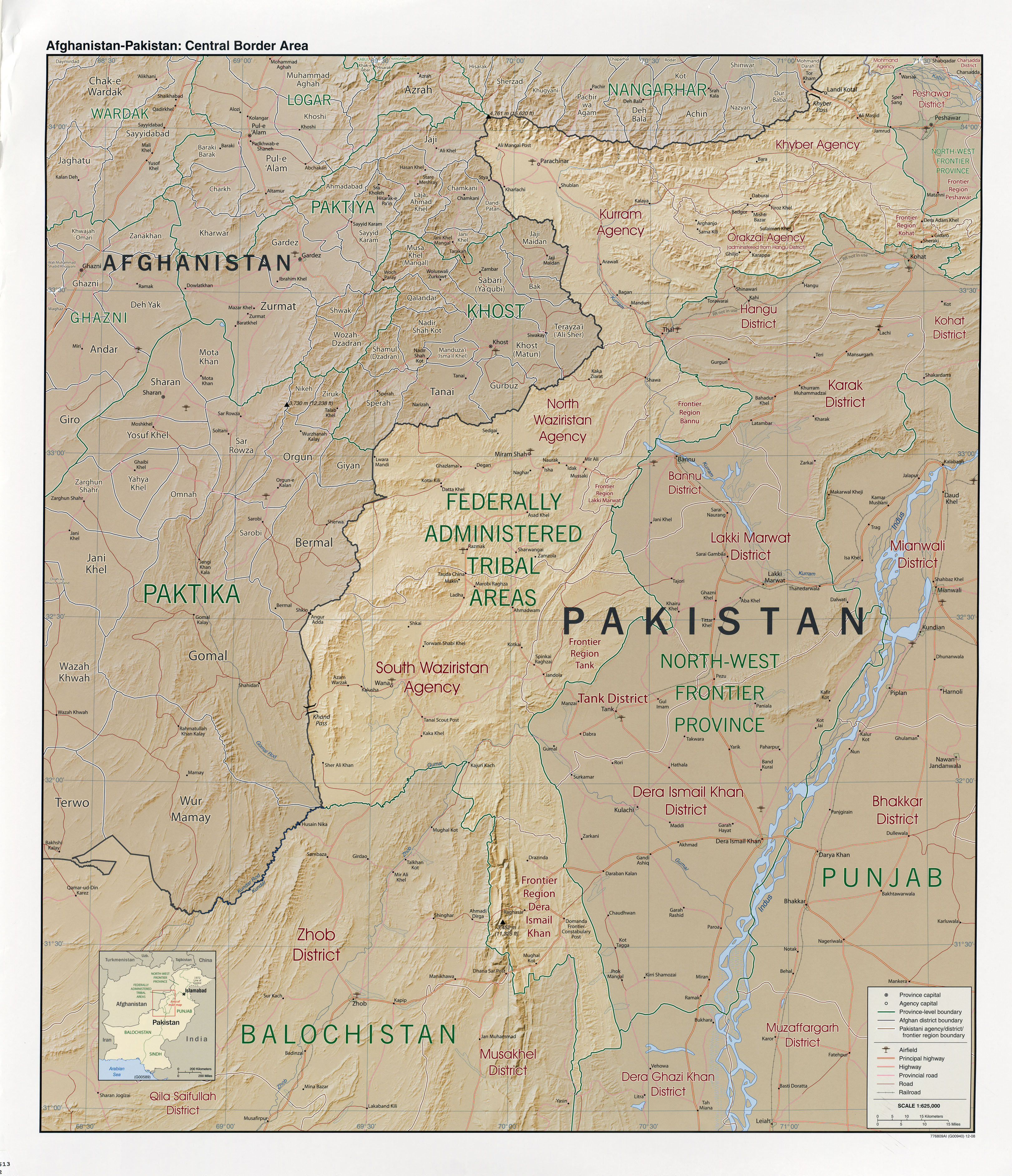
As many as 150,000 civilians have fled the area in the months leading up to the offensive, but an estimated 350,000 still remain. The UNHCR reported Friday, before the new offensive started, that getting care to the refugees is complicated by the security situation in Pakistan, as well as the estimated 2 million people who fled Swat, Buner, Shangla and Dir earlier this year.
Saturday, October 17, 2009
Pakistan's response
Tens of thousands of Pakistanis flee Southern Waziristan
Al Jazeera reported today that some 28,000 Pakistani soldiers launched a ground offensive against an estimated 10,000 Taliban, Uzbek and Arab Al-Qaeda militants in the Taliban stronghold of Southern Waziristan. Pakistani troops are advancing in three directions, and tens of thousands of civilians are fleeing in advance of the fighting.
The Pakistani army is advancing from Zhob to the south, Razmak to the north and Jandola from the east, and civilians are fleeing Shakoi and Zangra areas to Northern Waziristan. The UN has been preparing for a mass civilian exodus, and has set up makeshift refugee camps and has stockpiled food and supplies. (For a detailed map of the region, see the U. of Texas map collection.)
Southern Waziristan was the site of a Pakistani army offensive in 2004, and suffered heavy losses before the government signed a peace pact.
Pakistan Launches Taliban Assault
BBC News reports that Pakistan has launched an offensive against Taliban militants in the South Waziristan area that could last for up to two months according the to army's top spokesman.
Friday, October 16, 2009
Clinton expresses confidence in Pakistani Nukes
Secretary of State Hillary Clinton and British Secretary of State David Miliband said Sunday that they have confidence in the security of Pakistani nuclear weapons. The announcement came the day after an attack against a military command center in Rawalpindi. Two of the attackers had served in the Pakistani military, and all attackers were wearing army uniforms and took hostages at a heavily guarded military site. Read more at the Washington Post.
Thursday, October 15, 2009
5th attack in 10 days in Pakistan
In Lahore this morning, several militants attacked 2 police stations and the Federal Investigation Agency building while wearing law enforcement uniforms. In one of the police training facilities where 800 new recruits begun training, militants scaled a wall and begun a 2 hour battle in which one of those militants detonated a suicide bomb. Reports state that more than 30 people were killed. To read more, click here NYTimes.com.
Subscribe to:
Posts (Atom)